A woman stands at a bus stop in Seoul, unsure if she’s at the right spot, and turns to the middle-aged woman next to her: “아줌마, 이 버스가 서울역 가는 버스 맞나요?” (ajumma, i beoseuga Seoullyeok ganeun beoseu matnayo?) — “Excuse me, ma’am, is this the bus that goes to Seoul Station?” She has no idea who this woman is, no name to use, nothing in common with her except standing at the same bus stop — yet “아줌마” is exactly the right word to reach for. So what is the actual ajeossi and ajumma meaning, and why is it so natural to call a complete stranger something close to “auntie” just to ask a simple question? Ajeossi (아저씨) means a middle-aged man, and ajumma (아줌마) means a middle-aged woman — but the real story behind these two words, and the family terms that sometimes replace them, is more layered than any dictionary entry can show.
Ajeossi and ajumma meaning in everyday Korean
At their core, ajeossi and ajumma are simply Korean terms for middle-aged adults — someone old enough to be your parent, or at least noticeably older than you. Ajeossi refers to a man, usually somewhere in his 40s or beyond, and ajumma refers to a woman in the same general age range. A slightly more formal version of ajumma also exists: 아주머니 (ajumeoni), which softens the tone a bit and shows up more often in careful or polite speech, such as when you’re addressing someone you don’t know well but want to speak to respectfully.
What makes these words different from a plain age category in English is that they double as the default way Koreans address adults for whom they have no other relationship word. Korean conversation runs on relationship-based titles — you rarely call someone by their bare name unless you’re close in age or rank, and you almost never speak to a stranger without some kind of title. So when you need the attention of a middle-aged stranger, the man crossing the street ahead of you, the woman waiting beside you at the bus stop, you don’t reach for a neutral phrase the way English speakers might. You say 아저씨 (ajeossi) or 아줌마 / 아주머니 (ajumma / ajumeoni), and the word does double duty: it gets their attention, and it quietly states who they are to you — an unrelated adult, older than you, whose name you don’t know.
I tell learners not to treat these words as insults or as purely about age. Think of them as social placeholders. They exist because Korean rarely lets you address a stranger with nothing at all.
Korean uncle and aunt equivalents at the restaurant counter
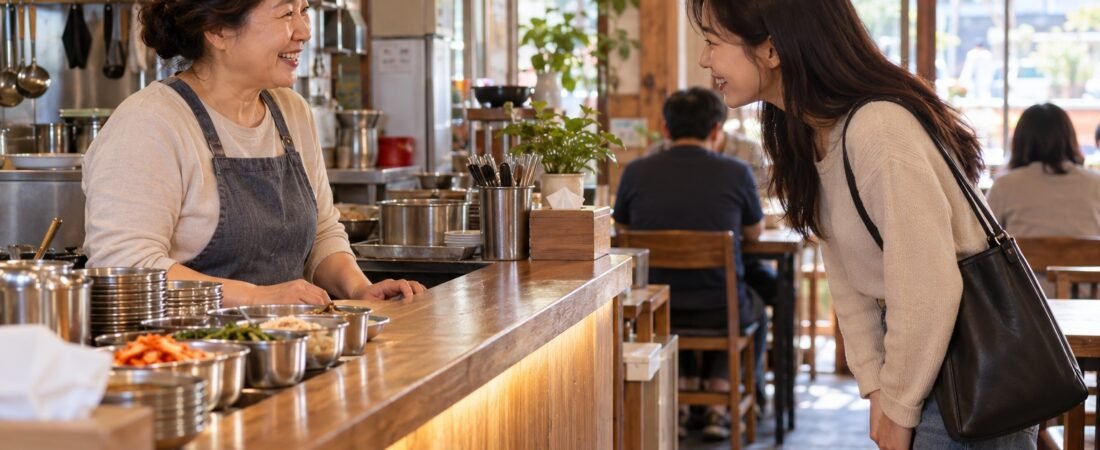
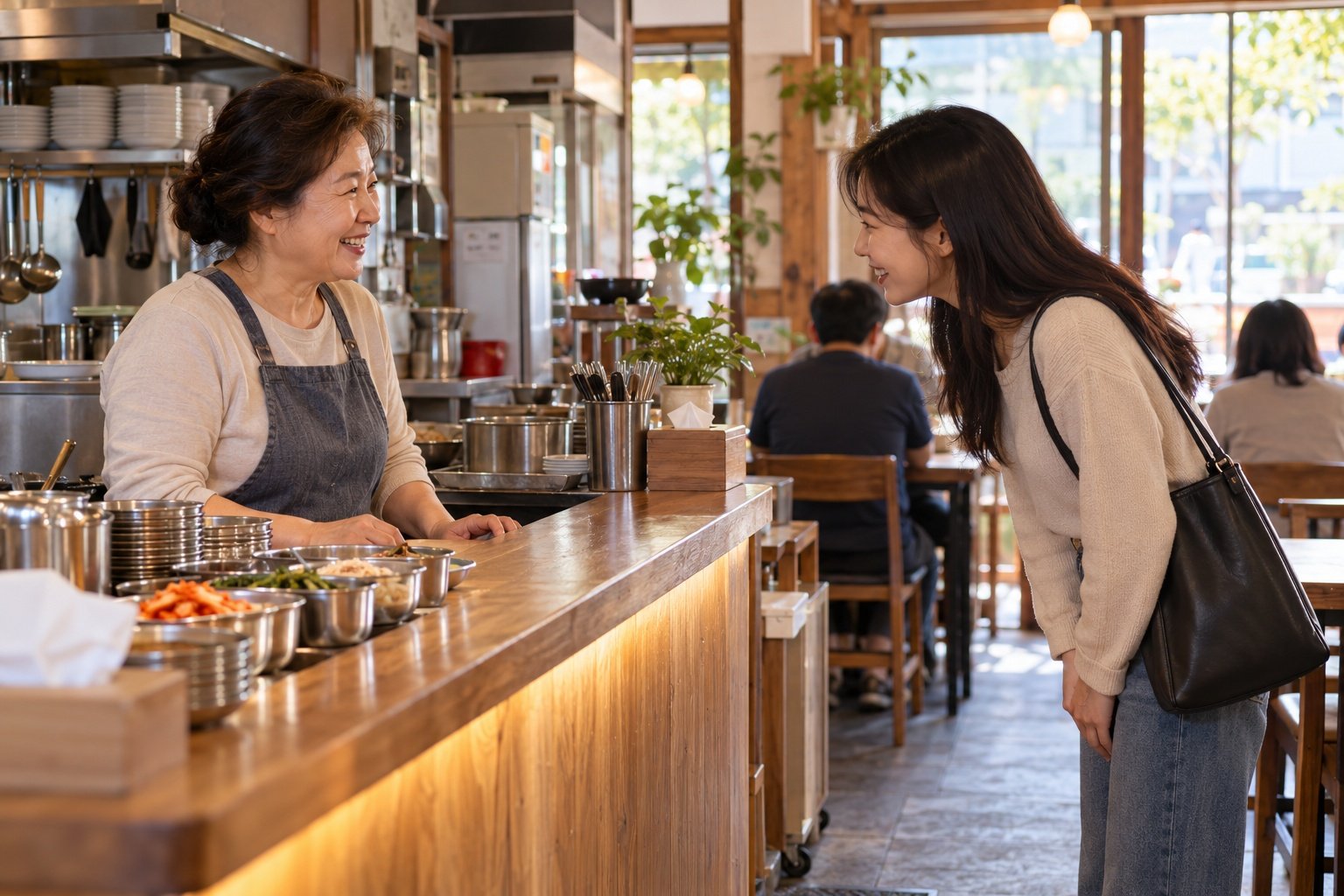
If you spend time in small restaurants and markets in Korea, you’ll notice something that trips up a lot of learners: the direction of who calls whom what. At a regular spot, it’s the customer who calls the owner 이모 (imo), literally “maternal aunt,” or 삼촌 (samchon), literally “uncle.” These are, technically, Korean uncle and aunt equivalents reserved for actual family — your mother’s sister, your parents’ brother — but customers borrow them for an owner they’ve come to feel comfortable with. The owner, however, doesn’t usually call the customer imo back; that direction doesn’t really work in Korean.
Instead, something more interesting can happen. An owner who feels genuinely close to a regular, and wants to show warmth, will sometimes call that customer 언니 (eonni) — “older sister” — as long as the customer isn’t old enough to be, say, the owner’s own mother. Eonni is technically a term for an older female relative or friend, so it does put the customer slightly above the speaker in age. But in practice, being called eonni communicates almost the opposite of “you’re old.” It says, “I still see you as close enough in age to be my older sister, not someone from another generation entirely.” That’s exactly why it works as a small, warm gesture, even from an owner who might in fact be older than the customer.
You can hear the whole exchange in one short scene. A regular walks in and says, “이모, 안녕하세요? 저 왔어요” (imo, annyeonghaseyo? jeo watseoyo) — “Hi, auntie, I’m here.” The owner calls back, “어! 언니 어서 와” (eo! eonni eoseo wa) — “Oh! Come on in, unni.” This exchange feels completely natural even between an owner in her 50s and a customer in her 20s, because eonni here isn’t really about age at all. It’s a deliberate, affectionate word choice, not something an owner uses for every customer who walks in.
Korean terms for middle-aged adults and why some adults prefer to skip them
So why would a middle-aged shop owner want to be called imo instead of ajumma or ajumeoni in the first place? The answer says a lot about how Korean social feeling works. Calling someone imo signals closeness, almost like saying “you feel like family to me,” even though the relationship began as a purely commercial one. A customer who calls an owner imo for years is building a small, pretend-family closeness that makes eating there feel personal rather than transactional.
This shift has also grown because plenty of middle-aged Korean women don’t especially enjoy being labeled ajumma anymore. The word can carry an unwanted image of being frumpy or simply “old,” even when no offense is intended, and ajumeoni only softens that slightly. Imo sidesteps the issue while keeping the sentence grammatically natural, since Korean still requires some title to address the person you’re speaking to.
That said, ajeossi and ajumma are not disappearing, and they are not inherently rude. In a one-time interaction — asking a stranger for directions, flagging down a taxi driver, or telling a friend about “the ajumma at the fruit stand” — they remain completely standard and expected. The shift toward imo mostly happens in relationships with some repeated contact, like a regular customer and a shop owner, not in passing encounters with strangers.
Ajeossi and ajumma meaning: who doesn’t want to be called this
Here’s where learners often get tripped up: age matters more than you’d expect, and misjudging it can genuinely sting. Ajeossi and ajumma are meant for people who look clearly middle-aged, generally 40s and up. Call someone in their late 20s or early 30s ajumma or ajeossi, and don’t be surprised if their face falls a little. Being seen as visibly “old” before you feel ready for that stage can feel like a small blow to the ego, and being mistaken for an ajumma or ajeossi too early is a classic version of that sting. For women there’s an extra layer worth knowing: in the Standard Korean Dictionary, 아주머니 used for a stranger specifically implies a married woman, so using it for someone young and unmarried doesn’t just make her sound older — it places her in a stage of life she hasn’t reached yet.
So when should you avoid these words altogether? The simplest rule: skip them for anyone whose age looks under about 35, or for anyone you suspect might not welcome being marked as middle-aged. In those cases, the neutral 저기요 (jeogiyo, “excuse me”) is always the safer choice — it gets attention without placing anyone in an age bracket. Calling a stranger ajumma or ajeossi isn’t rude in itself; Koreans do it constantly, and it’s an ordinary part of daily speech. The risk isn’t in using the word — it’s in using it on someone too young for it.
Interestingly, children are the ones most likely to use these words freely and innocently. A kid might run up to any woman around their mother’s age and call her ajumma without a second thought, because to a child, “ajumma” simply means “an adult woman who isn’t my mom.” There’s no judgment in it, just a category. Adults calculate more carefully, because they know the word carries a social weight a five-year-old hasn’t learned to register yet.
What to actually do with this
Next time you’re in Korea and need a stranger’s attention, take a second to look at them before you speak. If they’re clearly middle-aged or older, ajeossi or ajumma (or the more careful ajumeoni) is completely normal, and no one will think twice. If they have an obvious role, a shop owner as 사장님 (sajangnim) or a driver as 기사님 (gisanim) sounds even more respectful. If someone’s age is unclear, default to 저기요 (jeogiyo) and skip the guessing entirely. And if you ever become a regular somewhere, listen to what other regulars call the owner — if it’s imo or samchon, feel free to borrow it once you’re a familiar face. Don’t be surprised, either, if a warm owner starts calling you eonni one day. It isn’t a comment on your age at all. It’s simply Korean for “you’re one of us now.”