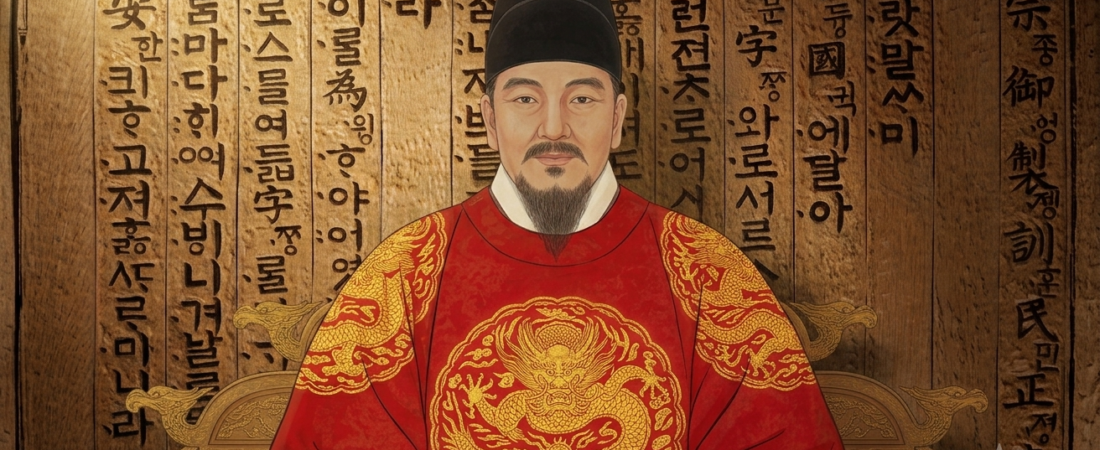
Every year on October 9, Korea takes a day off to celebrate its writing system. Schools close, flags go up, and families head out for a long autumn weekend. Most countries have holidays for independence, harvests or religious events. Very few have one for the letters they write with.
The day is called Hangul Day, or 한글날 (Hangeullal). It honors 한글 (Hangul), the Korean alphabet. To understand why Koreans care so much about it, it helps to know something many learners mix up at first.
Hangul is not the Korean language. The language is 한국어 (Hangugeo), the one people speak. Hangul is the script used to write it down. Koreans spoke Korean for many centuries before Hangul existed. For most of that time, they had no way to write their own speech the way they actually said it.
So when Koreans celebrate Hangul Day, they are not celebrating their language as such. They are celebrating the moment their language finally got letters of its own.
A King Who Felt Sorry for His People
Before Hangul, educated Koreans wrote in Classical Chinese, using Chinese characters called 한자 (Hanja). Learning thousands of characters took years of study. Only the elite had that kind of time. Farmers, merchants and most women could not read or write at all.
There was a deeper problem, too. Chinese characters were built for Chinese, a language with a very different structure. Korean has particles and verb endings that carry much of a sentence’s meaning. Squeezing Korean into Chinese characters was like wearing someone else’s shoes.
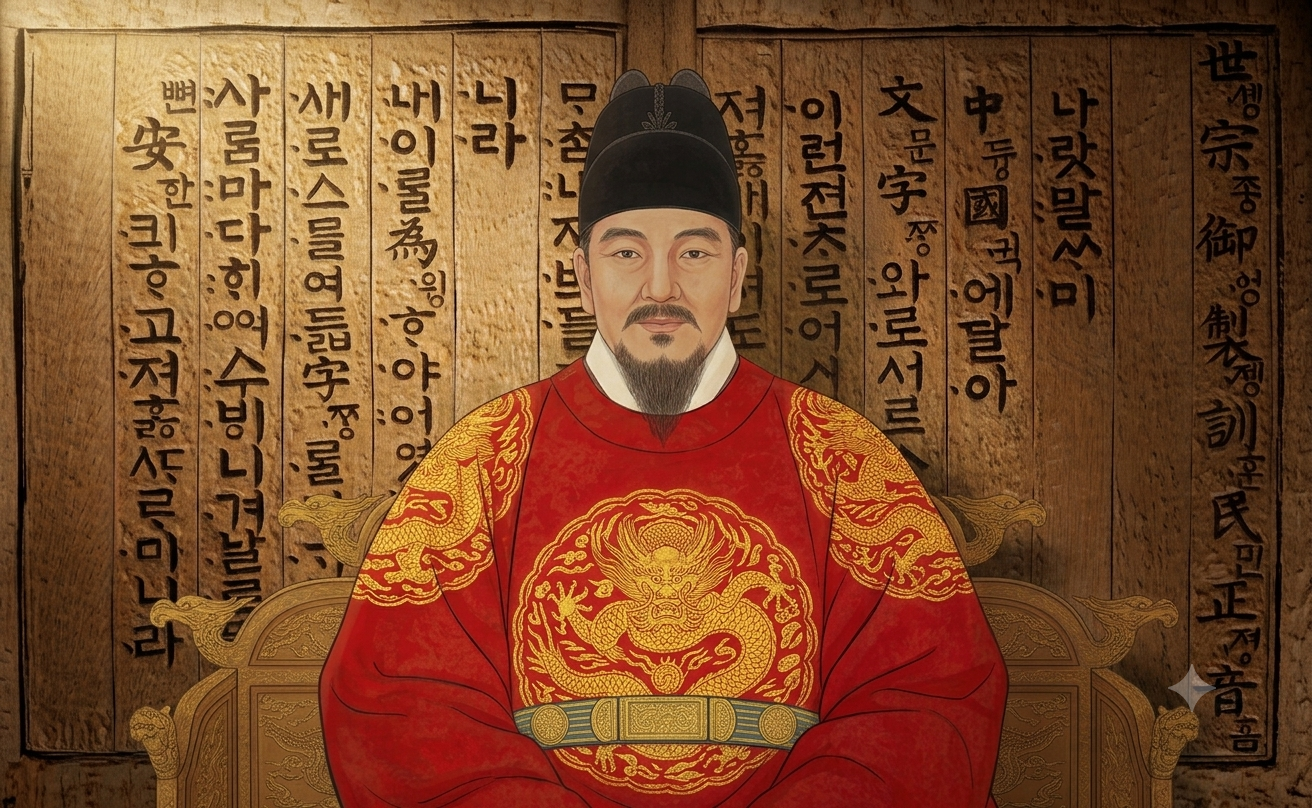
King Sejong (세종대왕, Sejong Daewang), the fourth king of the Joseon dynasty, decided to fix this. He completed a new set of letters in 1443 and published them in 1446. The book that introduced them was called 훈민정음 (Hunminjeongeum), which means “the correct sounds for teaching the people.”
Its preface is one of the most quoted passages in Korean history. Every Korean student learns its opening line: 나랏말싸미 듕귁에 달아 (naranmalssami dyunggue dara), written in the Korean of the 1400s. In plain English, the king says roughly this:
Our country’s speech differs from that of China, so it does not fit Chinese writing. Many ordinary people have things they want to say but can never put them into writing. I feel sorry for them, so I have made twenty-eight new letters. I simply hope everyone can learn them easily and use them comfortably every day.
That last wish is the heart of the whole story. Hangul was not made to look elegant or to impress scholars. It was made so that ordinary people could write down their own words.
Letters Shaped Like the Mouth That Says Them
What makes Hangul unusual is not just why it was made, but how. Most writing systems grew slowly over centuries. Hangul was designed on purpose, and its designers explained their thinking in writing.
The basic consonants are drawn from the shape of the mouth as it makes each sound. ㄱ (g/k) shows the back of the tongue lifting to block the throat. ㄴ (n) shows the tip of the tongue touching the ridge behind the upper teeth. ㅁ (m) is the shape of closed lips. ㅅ (s) looks like a tooth, and ㅇ is the round opening of the throat. Try saying each sound slowly and you can almost feel the letter inside your mouth.
Stronger sounds simply get an extra stroke. ㄱ becomes ㅋ, a harder k. ㄴ becomes ㄷ, and then ㅌ. Once you know the basic shapes, the rest of the family makes sense.
The vowels follow a different idea. They are built from three symbols: a round dot for heaven, a flat line (ㅡ) for the earth, and a standing line (ㅣ) for a person. Combine them and you get ㅏ, ㅓ, ㅗ, ㅜ and the rest. Over time the dot shrank into the short stroke you see today.
Finally, the letters are not written in a row like English. They are stacked into square syllable blocks. The word 한 is ㅎ + ㅏ + ㄴ, packed into one block. That is why a line of Korean looks like neat little squares, even though each square is made of simple letters.
King Sejong’s original set had 28 letters. Four of them fell out of use, so modern Korean uses 24. A scholar of the time wrote that a clever person could learn them before a single morning was over, and even a slow learner within ten days. Many learners today would agree.
The Long Road from “Vulgar Script” to National Pride
You might expect a script this practical to take over right away. It did not. Many scholars opposed it from the start. To them, Chinese characters were the writing of learning and civilization, and a script anyone could pick up in days seemed cheap.
For centuries, the upper class called Hangul 언문 (eonmun), a dismissive name meaning something like “common script.” Official records, exams and serious scholarship stayed in Chinese characters. One king, Yeonsangun, even banned its use in 1504 after anonymous posters written in Hangul criticized him.
Yet Hangul survived in everyday life. Women wrote letters in it. Buddhist texts, popular novels and farming guides were printed in it. Quietly, the script did exactly what Sejong had hoped. It gave ordinary people a voice on paper.
Things changed near the end of the 1800s, when the government began using Korean script in official documents. In the early 1900s, the linguist Ju Si-gyeong (주시경) helped give the alphabet the name it carries today. 한글 is often explained as “the great script” or “the one script.” For the first time, the name itself carried pride rather than contempt.
That pride mattered most under Japanese colonial rule, when the Korean language was pushed out of schools and public life. Keeping Hangul alive became a way of keeping Korea alive. In 1940, an original copy of the Hunminjeongeum Haerye, the explanatory edition of Sejong’s book, was found in Andong. It confirmed how the letters had been designed. Today it is a National Treasure, and in 1997 it was added to UNESCO’s Memory of the World Register.
How Hangul Day Came to Be
The holiday began in 1926, during the colonial period, when a group of Korean language scholars held the first celebration. They called it 가갸날 (Gagyanal), after the way children practiced syllables: 가, 갸, 거, 겨. Two years later it was renamed 한글날.
The date moved a few times before settling. The rediscovered Haerye recorded that the book was completed in early autumn of 1446. Converted to the modern calendar, that pointed to October 9, which has been Hangul Day in South Korea since 1945.
The holiday has had its own ups and downs. It was a public day off for decades, then lost that status in 1991, when the government felt there were too many holidays. Many Koreans were unhappy about it. After years of public campaigns, it became an official day off again in 2013.
North Korea also honors the alphabet, but on a different date. It celebrates 조선글날 (Joseongeullal) on January 15, linked to when the letters were first created rather than published. Even the name of the script is different there: 조선글 (Joseongeul) instead of 한글.
On the day itself, there is no special food or ritual like there is for Chuseok. Most people simply enjoy the day off. You will see events at the King Sejong statue in Gwanghwamun Square in Seoul, handwriting contests, and plenty of TV shows and articles pointing out odd loanwords and spelling mistakes. It is a holiday that invites Koreans to look at their own language a little more carefully.
What This Means When You Learn Korean
If you are learning Korean, you are already living out Sejong’s wish. Most learners can read Hangul within a few days. They may not understand the words yet, but they can sound them out on a menu, a subway sign or a K-pop album cover. Few writing systems let a beginner do that so quickly.
That ease is also why many teachers advise learners to stop relying on romanization early. Spellings like annyeong or gamsahamnida are only rough guides. Hangul shows the sounds of Korean far more accurately, because it was built for exactly those sounds.
Knowing the story behind the letters also changes how they feel. When you write ㄱ, you are drawing the back of a tongue. When you write ㅣ, you are drawing a person standing between heaven and earth. These are not random shapes to memorize. They are a small piece of design made nearly six hundred years ago, so that people who had never held a brush could finally write.
So if you are in Korea on October 9 and someone asks why the shops are closed, you can tell them. Korea is taking a day off to thank the letters that let everyone write. Then try writing your own name in Hangul. That is the best way to celebrate.
How Much Koreans Love Their Letters
If you spend time with Koreans, you will notice that Hangul is not just a tool to them. It is a quiet source of pride that shows up in everyday life, often in small and funny ways.
King Sejong is everywhere. His face is on the 10,000-won bill. His statue sits in the middle of Gwanghwamun Square, facing one of Seoul’s busiest roads. A major street, a performing arts center, a whole city and even Korea’s research station in Antarctica carry his name. In surveys of the most respected figures in Korean history, he almost always comes out at or near the top.
There is also a phrase you will hear when Koreans are reminded how easy their alphabet is: 세종대왕님 감사합니다 (Sejong Daewangnim gamsahamnida), “Thank you, King Sejong.” People say it half joking and half sincere. They say it when they type a long message on their phone in seconds, or when they hear how long it takes to learn thousands of characters elsewhere. It sounds like a joke, but the gratitude is real.
That phone typing is a story in itself. One of the most popular Korean phone keyboards, called 천지인 (Cheonjiin), means “heaven, earth, human.” It puts just three keys on the screen for vowels: a dot, a flat line and a standing line. These are the same three symbols Sejong used almost six hundred years ago. Many Koreans love pointing out that a design from the 1400s fits a smartphone so perfectly.
The pride also shows in how carefully Koreans treat their language. Every year around Hangul Day, the National Institute of Korean Language and the media suggest Korean words to replace unnecessary English loanwords. Teachers and parents take spelling seriously, and getting 맞춤법 (matchumbeop, spelling) wrong in a public notice can draw a lot of comments. To many Koreans, writing Korean well is a way of showing respect for what Sejong left behind.
And Koreans are deeply moved when foreigners take an interest. A foreigner wearing a T-shirt with Hangul on it, writing their name in Korean, or reading a menu out loud will almost always get a big smile. Behind that smile is a simple feeling. Hangul was made so that anyone could read and write. When someone from the other side of the world picks it up, Koreans see Sejong’s wish reaching further than he could ever have imagined.