Chuseok (추석): Korea’s Harvest Holiday, Explained
Chuseok is one of the two biggest holidays on the Korean calendar. For several days each autumn, roads and transport hubs become crowded as families travel to their hometowns. This guide explains what Chuseok is, how it is celebrated, and the Korean vocabulary you will hear around it.
Quick Answer: Chuseok (추석) is Korea’s harvest festival, celebrated on the 15th day of the 8th month of the lunar calendar — meaning the date shifts on the Western calendar every year. In 2026, Chuseok falls on September 24–26 (Thursday–Saturday). It’s often compared to Thanksgiving, but it’s built around ancestral rites and a mass return to one’s hometown, not a single shared meal.
What Is Chuseok?
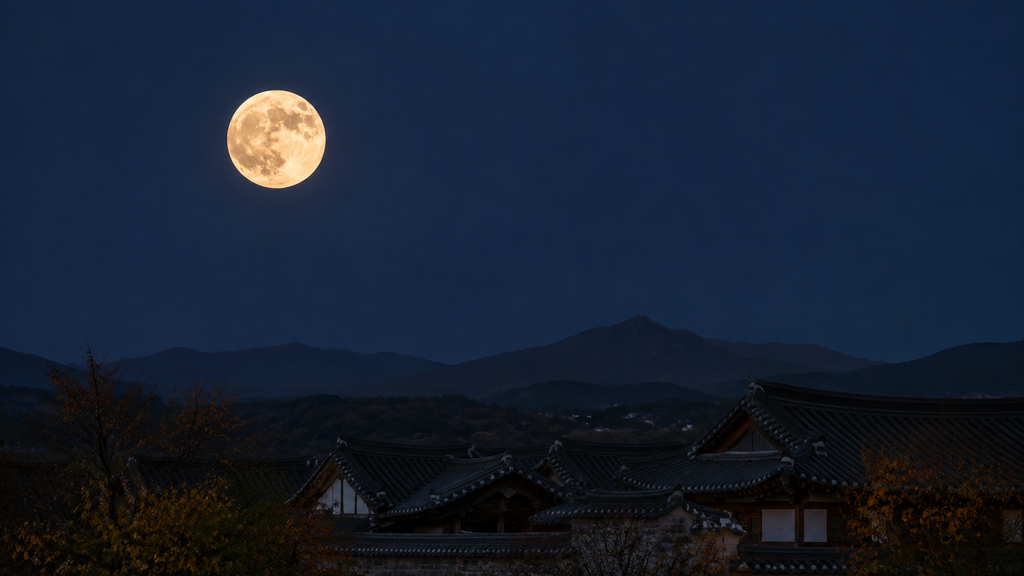
추석 (Chuseok), also called 한가위 (Hangawi), literally centers on the harvest moon — 추 (秋) means “autumn” and 석 (夕) means “evening.” It falls on the full moon of the 8th lunar month, historically the point in the year when the harvest was in and there was, for once, plenty to eat and time to give thanks.
The holiday itself is far older than most people assume. It grew out of agrarian society as a rite of thanks after the harvest, and customs resembling it are recorded as far back as the Samhan period — well over a thousand years ago — under different names. Originally, the thanks were directed at gods and nature spirits tied to the harvest; it’s specifically through centuries of Confucian influence, concentrated in the Joseon dynasty, that the focus of the ritual shifted toward ancestors — which is how charye, the ancestor-memorial rite, became the centerpiece of Chuseok morning that it is today. So it’s a mistake to file Chuseok itself under “Confucian tradition” — its roots go back long before Confucianism took hold in Korea — but the specific shape the ritual takes now, honoring ancestors rather than gods, is a real Confucian-era layer added on top of a much older harvest festival.
Because it follows the lunar calendar, the Western date moves around each year — usually landing somewhere between early September and early October. The government also designates the day before and after as public holidays, so Chuseok is effectively a three-day (sometimes longer, if it lines up with a weekend) national holiday.
What Actually Happens During Chuseok
귀성 (gwiseong) — the trip home. Chuseok traditionally centers on returning to your hometown (고향, gohyang) to spend time with extended family, especially parents and grandparents. Because many people travel at once, roads and public transportation can become exceptionally busy before and after the holiday.
귀성 (gwiseong) — the trip home. Chuseok is built around returning to your hometown (고향, gohyang) to be with extended family, especially parents and grandparents. Because so much of the country is doing this at once, the days before Chuseok produce some of the worst traffic of the year — a drive that normally takes a few hours can stretch to ten or more.
차례 (charye) — the ancestral rite. On the morning of Chuseok, families set a table of food for deceased ancestors — freshly harvested rice, fruit, and other dishes are arranged in a specific order, and the family bows in turn. It’s a way of thanking ancestors for the harvest and including them in the family gathering. Some families also visit and tidy ancestral graves around this time (성묘, seongmyo).
송편 (songpyeon) — the food. The signature Chuseok food is songpyeon, small half-moon-shaped rice cakes filled with sweetened sesame, beans, or chestnut, then steamed over pine needles, which give them a faint pine scent. Traditionally, making songpyeon together as a family — grandparents, kids, and in-laws all in the kitchen — was itself part of the holiday. These days, with everyone busier, a lot of families buy songpyeon instead of making it from scratch, and some skip it entirely — rice cakes aren’t exactly light eating, after all.
A Holiday That’s Changing
The strict version of Chuseok described above is increasingly the older generation’s version of it. Fewer families now perform charye with the full formality it used to have, and this shift isn’t only a Christian thing — more households without any religious reason are simply choosing to scale back or stop the ancestral rite altogether. Food has changed too: with food no longer scarce the way it once was, many families skip the elaborate, all-day spread of traditional dishes and instead just cook and share whatever the family actually likes to eat together. The result is a smaller, more relaxed version of the holiday than what older generations grew up with — still centered on family, just with less ritual obligation attached to it.
One knock-on effect: families no longer tied down by charye preparations increasingly use a long Chuseok stretch to travel abroad instead of, or in addition to, visiting relatives. So alongside the highway traffic from gwiseong, airports get just as packed during Chuseok, filled with a mix of people flying to see family and people heading out on holiday trips.
Chuseok vs. Thanksgiving
The Thanksgiving comparison is useful but not exact. Both are harvest-rooted holidays centered on food and family, and both involve serious travel. But Chuseok leans more heavily on formal ancestral ritual (charye) than most Western Thanksgivings do, and the “going home” element is more intense and more universal — nearly the entire country is moving over the same few days, rather than gatherings being spread out.
Common Chuseok Greetings
- 즐거운 추석 보내세요 (jeulgeoun chuseok bonaeseyo) — “Have a happy Chuseok”
- 풍성한 한가위 되세요 (pungseonghan hangawi doeseyo) — “Have an abundant Hangawi” (a more traditional phrasing)
- 추석 잘 보내세요 (chuseok jal bonaeseyo) — “Have a good Chuseok”
These are the standard things to say to coworkers, friends, or neighbors in the days leading up to the holiday — similar to how “Happy Thanksgiving” gets used in English.
Quick Vocabulary
| Korean | Meaning |
|---|---|
| 추석 (chuseok) | Chuseok / the holiday itself |
| 한가위 (hangawi) | Another name for Chuseok, more traditional/native Korean |
| 귀성 (gwiseong) | Returning to one’s hometown for the holiday |
| 고향 (gohyang) | Hometown |
| 차례 (charye) | Ancestral memorial rite performed on Chuseok morning |
| 성묘 (seongmyo) | Visiting and tending ancestral graves |
| 송편 (songpyeon) | Half-moon rice cakes, the signature Chuseok food |
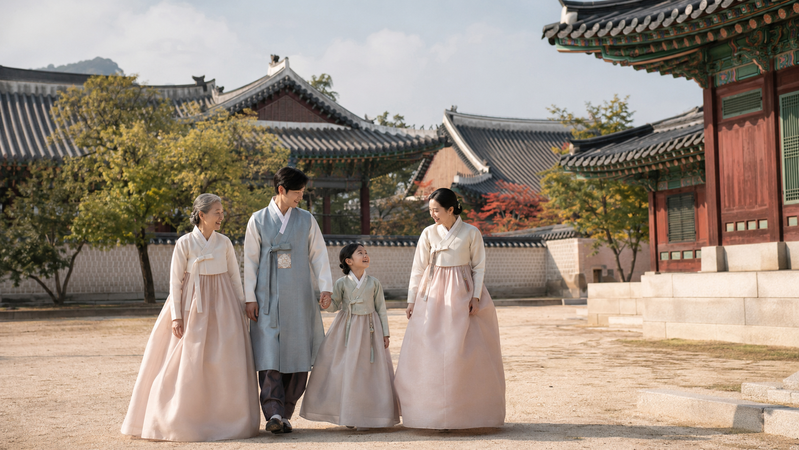
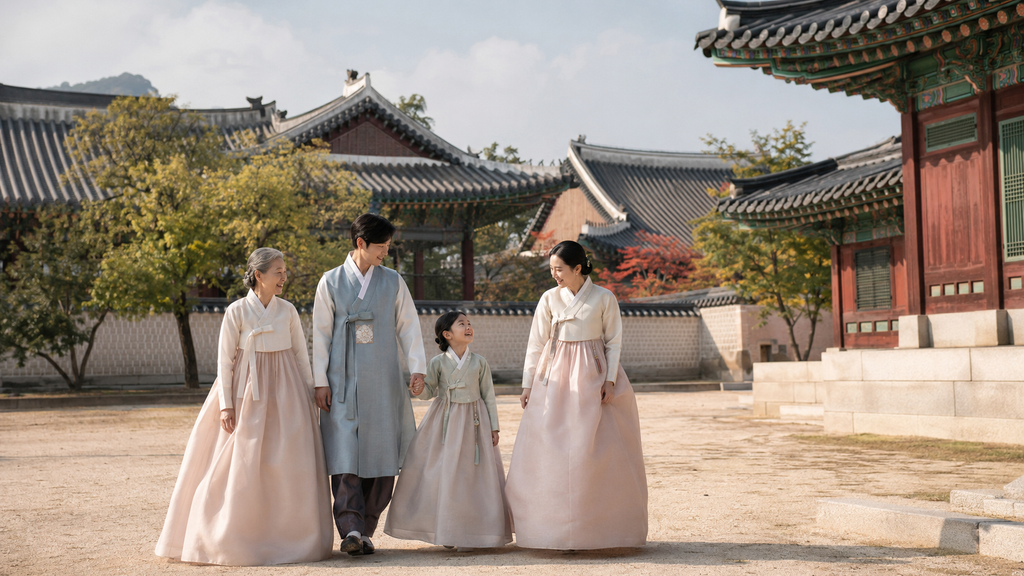
| 한복 (hanbok) | Traditional Korean dress, often worn on Chuseok |
| 보름달 (boreumdal) | Full moon |
| 용돈 (yongdon) | Pocket money — often given by elders to younger family members before they head back to the city |
FAQ
Is Chuseok the same date every year? No. It follows the lunar calendar, so the Western-calendar date changes annually. It always falls on a full moon in autumn.
What are the 2026 dates? September 24–26, 2026 (Thursday to Saturday).
Do people give gifts for Chuseok? It happens, but the gift-giving that gets talked about most is fairly specific: companies giving gift sets to employees, businesses giving gifts to VIP customers, and people giving gifts to older relatives they don’t get to see often the rest of the year. Among peers and younger people, gift-giving is actually fairly muted — there’s a quiet, mutual understanding that gifts can feel like a burden, so many friends and coworkers simply don’t exchange them. One reason gifts to elders matter less than you might expect: it’s very common for the flow of money to go the other direction, with grandparents or parents handing their kids and grandkids cash (용돈, yongdon — “pocket money”) as they head back to the city after the holiday.
Is Chuseok a religious holiday, or a Confucian one? Not originally, though it’s picked up a Confucian layer over time. Chuseok comes out of agrarian society — a rite of thanks after the autumn harvest — and customs resembling it are recorded as far back as the Samhan period, over a thousand years ago, under different names. Back then the thanks were aimed at gods and nature spirits; it was later, under centuries of Confucian influence concentrated in the Joseon dynasty, that the focus shifted to ancestors, which is why the modern holiday centers on charye, the ancestor-memorial rite. So the festival itself predates Confucianism in Korea, but the ancestor-focused ritual at its core is a Confucian-era addition to a much older harvest custom. Today, families observe it as a cultural and family custom regardless of personal faith, though some Christian families skip or adapt the ancestral rite.
What should I say to a Korean friend or coworker around Chuseok? “즐거운 추석 보내세요” (Have a happy Chuseok) is the safe, standard greeting.
I’m planning a trip to Korea — should I avoid Chuseok? If you can, yes — and the same goes for Seollal (설날, Korean Lunar New Year), the other major holiday built around the same gwiseong travel rush. During both, domestic transportation is jammed, flights and hotel prices spike, and plenty of small restaurants and shops close since owners are traveling too. Some tourist sites do run special Chuseok events, but if your main goal is convenient travel rather than experiencing the holiday itself, it’s easier to plan around these dates than through them.
Sources: