
A Sound for Whatever Just Happened to You
Stand in a Korean convenience store, subway car, or family kitchen long enough and you will hear it: a short exhale of a word, 아이고 (aigoo), dropped into conversation the way English speakers drop “ugh” or “oh no” — except this one works for pain, relief, shock, and sympathy, sometimes all within the same five minutes. A grandmother groans it getting up off the floor. A mother sighs it watching her toddler spill juice across the table. A friend murmurs it hearing bad news that isn’t even hers. None of these people would say they are using three different words. They are using one.

That is the first thing to understand about 아이고. It is not vague because Korean lacks a more precise word. It is broad on purpose, because the feeling it points to — something sudden landing on you, with your body reacting before your mind has time to pick a response — is itself broad. Pain, exasperation, sympathy, relief, mild shock: all five are really one category wearing different clothes, and 아이고 is the sound for that category.
Where the Word Comes From
To see why it stretches so far, it helps to go back to where 아이고 started, which is a heavier place than a stubbed toe. Older dictionaries and traditional usage trace the sound back to 곡 (gok), the ritualized wailing performed at Korean funerals. When a parent died, children expressed their grief not by crying quietly but out loud, chanting 아이고, 아이고 in a steady rhythm — and this is literally called 곡을 하다 (“to perform gok”). The grief was meant to be heard: the more sorrowful the wailing, the more fully a child was showing the world the depth of losing a parent. Crucially, this was not only spontaneous sobbing — it was a social duty, and even today mourners at a Korean funeral will sometimes take up the 아이고, 아이고 chant deliberately, performing the grief as much as feeling it. That is the heavy root the everyday word grew out of: 아이고 began as the sanctioned sound of letting profound pain out through your mouth instead of holding it in.
That origin matters because it explains the shape of the word, not just its history. 아이고 was never meant to describe a feeling calmly from the outside. It was built to let a feeling out involuntarily, the way a gasp or a wince escapes you before you decide to let it. Over generations, that same involuntary release attached itself to smaller and smaller pains — a sore back, a missed bus, a dropped plate — until it became Korea’s default exhale for almost anything that lands on you out of nowhere, good or bad.
The Many Moods of One Syllable
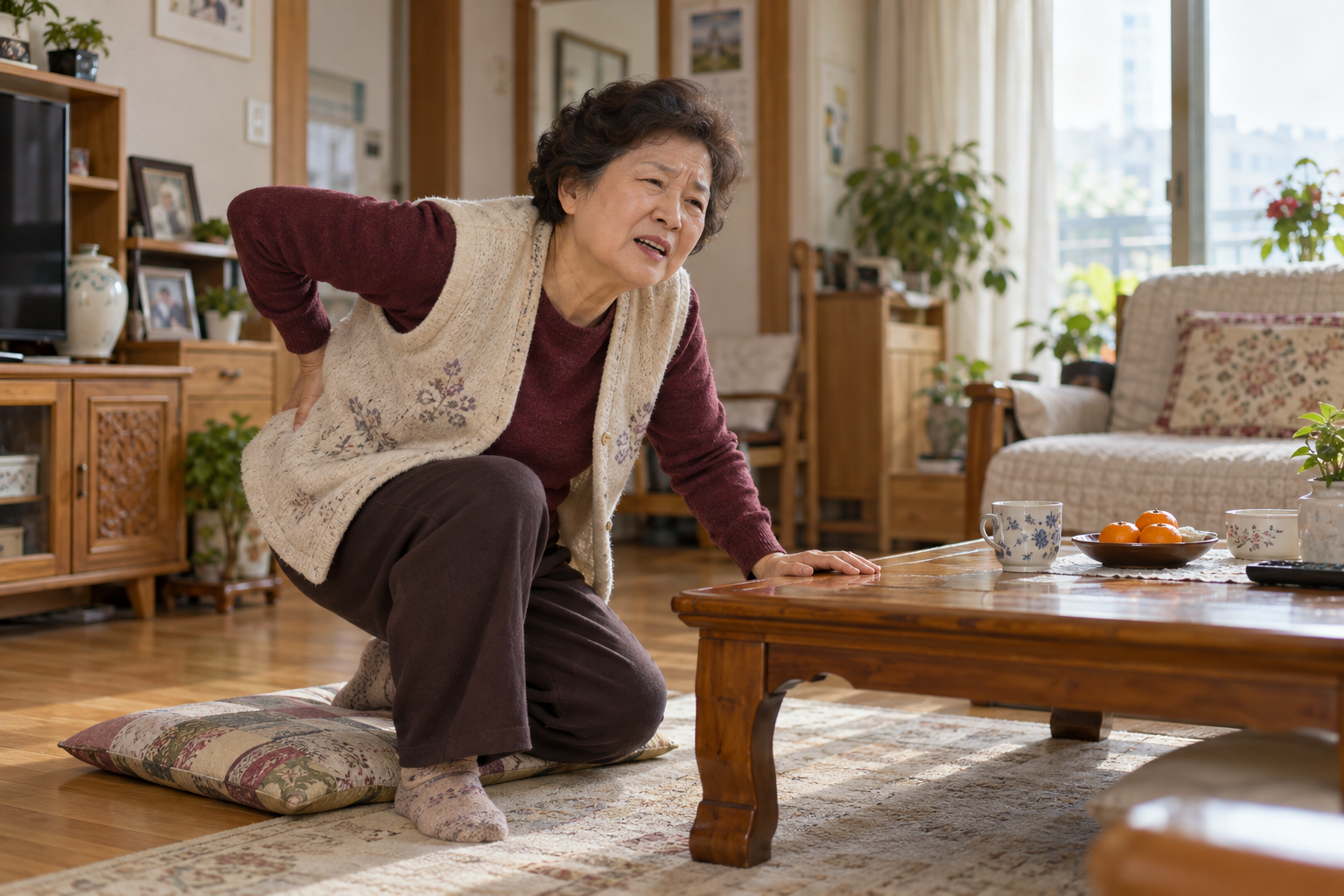
The fastest way to understand 아이고 is not to memorize a definition but to watch it in action. If you have seen a few Korean dramas, you have already heard most of these — the word tends to arrive at exactly the emotional beats a drama is built on. Here is the same sound doing completely different jobs:
- In pain: a grandmother pushing herself up off the floor sighs 아이고, 허리야! (“oof, my back!”). This one is so tied to older Koreans that it has become an affectionate cultural joke of its own.
- Startled: someone sneaks up behind you and you jump — 아이고, 깜짝이야! (“gah, you scared me!”).
- Sympathy for someone else: a friend says they lost their wallet, and you wince on their behalf — 아이고… 어떡해 (“oh no… what are you going to do?”).
- Relief: the lost wallet turns up after all — 아이고, 다행이다 (“oh thank goodness”).
- Exasperation: a child spills the milk for the second time — 아이고, 참 (“oh, honestly…”).
- Delight at seeing someone: you run into an old acquaintance — 아이고, 이게 누구야! or 아이고, 너무 반가워요 (“well, look who it is! / oh, so good to see you”).
- Touched but flustered by a gift: a guest arrives with their hands full, and you half-protest while clearly pleased — 아이고, 뭐 이런 걸 다 들고 왔어요 (“oh, you really shouldn’t have”). To a foreigner this can look backwards — why scold someone for a gift? — but that gentle protest is exactly how warmth and a touch of “you’re too kind” get expressed at once.
That is seven situations and one word, stretching from physical pain all the way to delight — and the list could go longer. Nobody is confused in the moment, because Korean speakers are not parsing a dictionary definition; they are hearing a tone of voice attached to a very recognizable kind of moment. Think of 아이고 less as a word with a meaning and more as the door almost any strong feeling can come out through. Its close cousin 아이구 (aigu), with a slightly different vowel, shows up interchangeably and should not be treated as a separate word at all.
A Word That Skews Older
아이고 also carries a generation on its back. Because it is tied to an older style of vocalizing effort and discomfort out loud, you hear it constantly from Koreans in their fifties and beyond, and somewhat less from Koreans in their twenties, who more often reach for newer slang instead. That does not make it old-fashioned so much as grounded — closer to how a grandparent talks than how a teenager texts. Which is part of why, when a foreigner uses it well, the reaction is so often warm rather than amused: it reads as picking up something genuine rather than performing slang, and older Koreans in particular tend to notice.
Aigoo Next to Its Neighbors
Korean has no shortage of exclamations, and 아이고 only makes full sense once you see where it sits among them. 헐 (heol) reacts to something surprising or absurd — closer to “what” or “no way” — and belongs to a younger, more slang-coded register than 아이고 ever will. 어머 (eomeo), used mostly but not only by women, leans toward being scandalized, closer to “oh my”; 아이고 is more physical, more about effort or discomfort, and used just as readily by men. And 아이참 (ai-cham) is lighter still, a playful half-complaint aimed at someone you are fondly annoyed with, where 아이고 carries real weight behind it, whether that weight is pain, relief, or sympathy.
Where Learners Go Wrong
The mistake most learners make is deciding early on that 아이고 means “oh no” and leaving it there. It does mean that, sometimes — but just as often it is doing the opposite job, marking relief or sympathy rather than distress, and a learner who only ever hears “oh no” in it will misread half the sentences it shows up in.
The second mistake runs the other way: reaching for 아이고 in a moment too serious for it. It fits a stubbed toe, a missed bus, a minor scare — not a genuine tragedy, where its everyday lightness can come across as understating what happened. And a third, smaller trap is dropping it into a formal setting, like a business meeting, where its casual, almost involuntary tone sits oddly against the occasion. 아이고 belongs to ordinary life and ordinary relationships, not to a podium.
Why It’s Worth Learning Anyway
None of this makes 아이고 risky to use — if anything, the opposite. It is casual without being impolite, which is why you will hear it from people of every social standing, including the people everyone else in the room defers to. A foreigner who uses it naturally, in the right small moment — stubbing a toe, hearing a friend’s bad day, finally finishing a long task — tends to land well precisely because the word has no cool factor to perform. It only has a feeling to let out.
So the next time something lands on you — a stack of paperwork, a stubbed toe, news that could have gone worse — try letting the sound out instead of translating the feeling into English first. 아이고. That, more than any definition, is what the word is for.