
The first time a Korean coworker asks how old you are, it can feel oddly personal. You have barely exchanged names, and already the question is your birth year. But the question is not really about you. It is about the next sentence. Until two Koreans know who is older, neither of them can be completely sure how to finish speaking, because in Korean the level of respect is not an attitude you add on top of your words. It sits inside the grammar, at the end of almost every sentence.
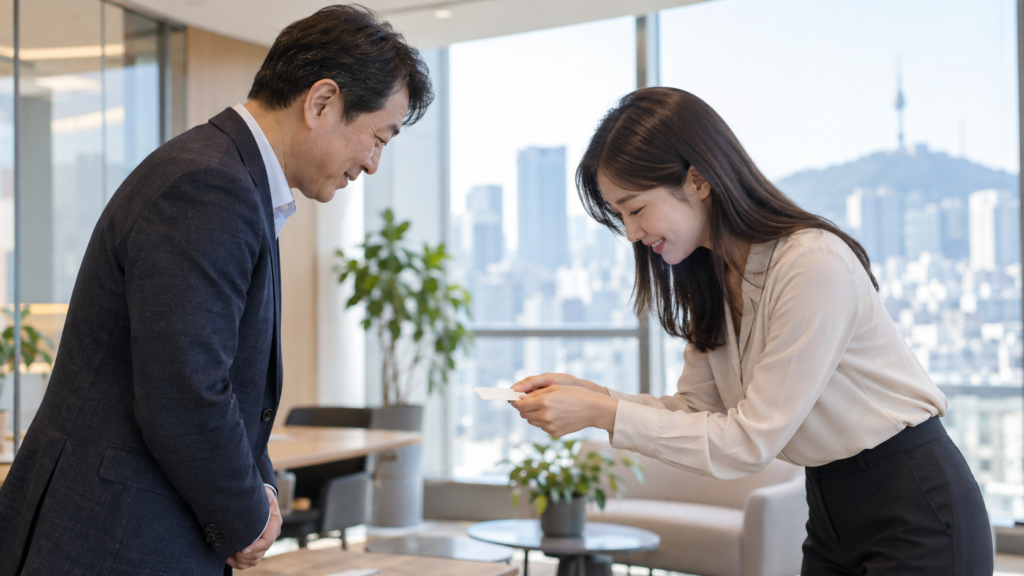
What Separates 존댓말 From 반말
Korean has two broad ways of speaking. 존댓말 (jondaetmal) is polite speech, and 반말 (banmal) is casual speech, literally “half words.” The difference usually lives in a small ending on the verb. A friend might ask you “밥 먹었어? (bap meogeosseo?)”, “Did you eat?” Add one syllable and it becomes “밥 먹었어요? (bap meogeosseoyo?)”, the same question asked politely. That little 요 (yo) carries the whole relationship.
English speakers often assume this works like the difference between “hey” and “hello,” a matter of tone. It goes deeper than that. You can be very rude in perfectly formal English, and very warm in casual English, because politeness in English is mostly word choice. In Korean, the speech level you choose is a statement about where you and the listener stand. Speaking 반말 to someone who has not invited it is not simply relaxed; it quietly claims a closeness or equality the other person has not agreed to. That is why it can land as genuinely disrespectful.
Within 존댓말 there are layers, and the difference between them matters. The style you hear most is 해요체 (haeyo-che), the -요 endings: “점심 드셨어요? (jeomsim deusyeosseoyo?)”, “Have you had lunch?” Korean grammar describes 해요체 as a 두루높임 (duru-nopim), a “general-purpose” polite style: it is informal, soft, and friendly, and it does not mark a clear gap in rank. Above it sits 합쇼체 (hapsyo-che), the formal style with endings like -습니다 and -습니까: “처음 뵙겠습니다 (cheoeum boepgetseumnida)”, “Nice to meet you.” Grammar books call it 아주높임 (aju-nopim), the highest level of respect, and it is the style of presentations, news broadcasts, apologies, and anyone speaking up a clear hierarchy.
That difference explains a lot. 해요체 feels polite but relaxed, the way you might speak to someone roughly on your level whom you do not know well yet. When the ranking is clear and steep, many Koreans feel that 해요체 is not respectful enough and shift up to -습니다. Traditionally, speaking to elders or superiors meant being 깍듯하다 (kkakdeut-hada), properly and scrupulously polite, and that meant the formal endings. 해요체 itself only became the everyday default fairly recently; it spread into public life around the 1990s and settled into daily speech in the 2000s.
Why Koreans Ask Your Age So Quickly
Once you see that the grammar changes with the listener, the age question stops looking nosy. It is closer to asking which side of the road to drive on. Age, and in workplaces seniority, decides who speaks to whom in which way, and Korean media such as The Korea Herald have described how deeply this age-based order is woven into the language itself.
It also explains one of the most distinctive moments in Korean friendships: the switch. Two people close in age who keep meeting, new classmates or coworkers who have started to get along, will often make the change out loud. One of them says “우리 말 놓을까요? (uri mal nolkkayo?)”, “Shall we drop the formal speech?” Or the older person offers “말 편하게 하세요 (mal pyeonhage haseyo)”, “Feel free to talk to me casually.” Only after that small agreement does 반말 become natural. Once they have agreed, the conversation relaxes into something like “우리 이제 말 놓을까? (uri ije mal nolkka?)” followed by “어, 그러자! (eo, geureoja!)”, “Yeah, let’s!”
So what do Koreans do when they are not sure? In most cases they start in 해요체. Unless the hierarchy is obvious from the start, two adults meeting for the first time, even when one is clearly older, will usually open politely and let the relationship settle before anything changes. The exceptions are situations where the ranking is already fixed. A senior student who walks into a junior class at school will simply speak 반말 to the younger students, and they will answer in 존댓말, because everyone already knows who is 선배 (seonbae, senior) and who is 후배 (hubae, junior).
Permission to use 반말 also tends to flow from the older or more senior person. An adult talking to a small child uses 반말 without a second thought, as in “몇 살이야? (myeot sariya?)”, “How old are you?”, and nobody finds it rude. But that does not mean age alone gives anyone the right to speak casually. When Koreans want to show respect, they avoid speaking 반말 to a stranger even when that person is clearly younger: a customer talking to a young shop assistant, or a manager meeting a new employee in their twenties, will usually still use 해요체. Speaking 반말 to a younger adult you have just met can come across as looking down on them.
When 존댓말 Stays for Good
Closeness does not always end in 반말. Many Korean relationships keep 존댓말 for years, even when they are warm. A son-in-law usually speaks politely to his wife’s parents, and a junior employee often stays in 존댓말 with a much older manager no matter how friendly they become. In these cases the respect in the grammar does not mean distance; it is simply how the relationship is expressed.
Families are where the picture has changed most. In the past, many children spoke 존댓말 to their parents and grandparents, and some families still keep that habit. Today, many families speak comfortably in 반말 at home, with children talking casually to their parents, while formal speech is saved for in-laws or older relatives on special occasions. Both are normal; each family draws its own line.
This is also where learners who study Korean through dramas can slip. Characters in a drama use 반말 because the story has already established their relationship. Copying that tone with a real stranger or an older person skips the step where that closeness was earned.
How to Use This as a Learner
The safest approach is simple, and it is exactly what Koreans themselves do. Start in 해요체 with anyone you do not know well, move up to -습니다 when the setting is formal or the person is clearly your senior, and let the other person lead any move toward 반말. If an older friend tells you “말 편하게 해 (mal pyeonhage hae)”, “Talk casually with me,” that is your invitation. If a Korean uses 반말 with you first, it is usually not an insult; people who are older or more senior often speak downward that way as a matter of course. Getting speech levels right is less about memorizing endings and more about reading the relationship, and Koreans notice and appreciate a learner who does it with care.