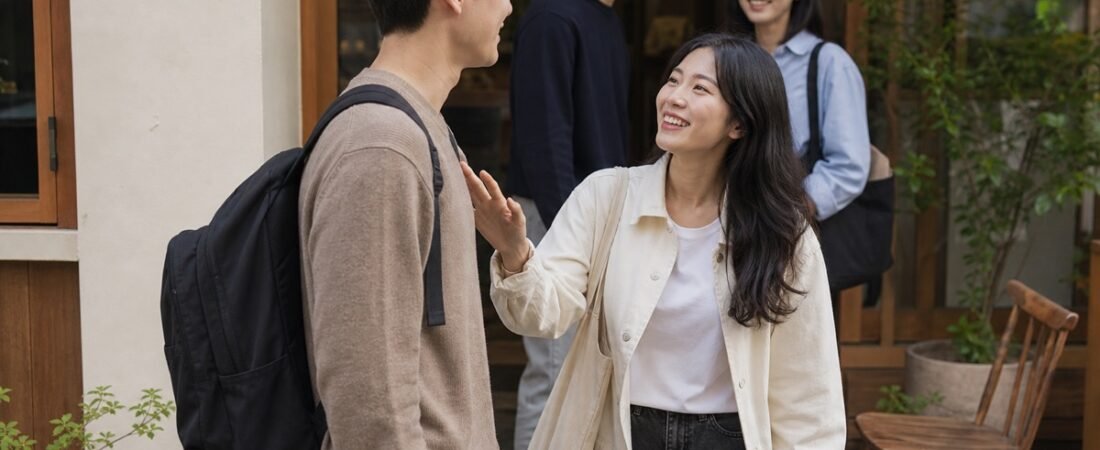
Oppa (오빠) Meaning: Who Can Say It in Korean?
If you’ve spent any time around Korean pop culture, you’ve heard “oppa” — shouted, sung, or said with real warmth. Outside dramas and lyrics, though, oppa is an everyday Korean kinship word that comes with its own grammar: who can say it, to whom, and in what setting.
Quick Answer: Oppa (오빠) means “older brother,” but only a female speaker uses it, and only for someone older and male. A male speaker uses a different word — hyung (형) — for the same relationship. Whether oppa sounds affectionate, casual, or completely inappropriate depends less on the word itself and more on two things: how well the listener knows your relationship with the person you’re calling oppa, and how formal the setting is.
What Does 오빠 (Oppa) Mean?
오빠 (oppa), pronounced roughly “oh-ppa,” is a Korean kinship term meaning “older brother” — used exclusively by female speakers. The double consonant ㅃ is pronounced “tensed,” slightly harder and sharper than a regular ㅂ, a feature Korean has that English doesn’t really match.
Korean doesn’t have one neutral word for “older brother” the way English does. The term depends on the speaker’s gender:
- A woman refers to her older brother as 오빠 (oppa)
- A man refers to his older brother as 형 (hyung)
Both mean “older brother,” but they aren’t interchangeable — the rule is about who is speaking, not who is being addressed. In practice, this tracks how the speaker identifies rather than any official test, but the grammatical convention itself is built around this male/female speaker split.
Beyond Biological Siblings
Korean speech culture generally avoids using a bare first name for someone older or unfamiliar, so kinship-style titles fill that gap. As a result, women commonly call these people oppa too, not just biological brothers:
- An older male cousin
- A close older male friend
- An older male senior at school, work, or in a club
- A boyfriend, if he’s older — very common in casual, spoken Korean
- A husband, informally, especially early in a relationship or at home
This dual role — respectful title and affectionate term — is exactly why oppa shows up so often in entertainment. It isn’t inherently romantic; it becomes romantic, stays platonic, or turns purely functional (as a workplace title-substitute) entirely based on the relationship and the setting.
Oppa at the Office: Closeness Doesn’t Override Formality
This is where a lot of learners get tripped up. Even if a woman is genuinely close to an older male colleague — close enough that she’d call him oppa outside of work — using oppa at work is considered inappropriate, no matter how comfortable the relationship is. The workplace has its own address system, built on job titles or a name followed by the honorific 님, and it overrides personal closeness.
Take a coworker named 김민철, who also happens to be her school senior (선배):
- In private, off the clock: she can call him 민철오빠.
- At the office: the appropriate address is 민철님, or by his title — 김대리님, for example, if he holds the position of 대리 (assistant manager).
The relationship underneath doesn’t change; the register does. Calling a colleague oppa inside the office reads as unprofessional regardless of how close you actually are, which is why Korean speakers keep a fairly hard line between how they address someone privately and how they address the same person at work.
Oppa in Everyday Conversation
Casual, personal context:
Jieun: 오빠, 이거 먹어봤어? (Oppa, have you tried this?) Minho: 아니, 처음 봐. 뭐야? (No, I’ve never seen it. What is it?)
Jieun is younger, so she uses oppa instead of Minho’s name. Minho, being older, can simply use her name.
Workplace context — same closeness, different address:
Somin: 민철님, 이 보고서 좀 봐줄 수 있어요? (Minchul-nim, could you take a look at this report?) Minchul: 어, 잠깐만. (Sure, one second.)
Here 님 functions as the neutral, professional way to address a colleague — even one Somin might call oppa outside the office. In formal writing, like a work email, Korean speakers switch to job titles or 님 entirely; oppa doesn’t appear in writing like this.
When Oppa Means “Boyfriend” or “Husband” — and When It Doesn’t
Oppa formally refers to a biological older brother, but it’s also the everyday way many women address a boyfriend or husband. That said, this usage is casual by nature, and it gives way to more formal terms in front of elders or in formal settings.
For a husband specifically, common alternatives in those contexts include:
- 남편 (husband) — the neutral, formal term
- 김서방 — used mainly by the wife’s parents and other elders/seniors on her side of the family; the husband’s surname is attached to 서방, and this combined form is how those senior family members address or refer to him. (Younger siblings-in-law and their spouses use separate terms of their own — that’s a more detailed topic for another time.)
- “[Child’s name]’s dad” (누구 아빠) — once there’s a child, referring to the husband by the child’s name plus “dad” is extremely common and considered more appropriate than oppa in family or formal settings
So calling your husband oppa at home is completely normal, but at a formal gathering or in front of elders, switching to 남편, 김서방, or “OO 아빠” is the expected move.
The Real Rule Behind Oppa
Put all of this together and the underlying rule becomes clearer than any list of “who can say oppa”: aside from an actual biological older brother, oppa is a casual, informal term reserved for people in casual, informal settings — and specifically for people whose listeners already understand the relationship.
In other words, you use oppa with someone when the people around you know how you two know each other. If the listener doesn’t have that context — a stranger, a formal acquaintance, someone at work who doesn’t know your personal relationship with that person — oppa isn’t the right word, no matter how close you actually are to him. In those situations, the formal, relationship-specific term takes over: 남자친구 (boyfriend), 남편 (husband), 선배 (senior), 회사동료 (coworker), and so on.
Oppa in Fan Culture: When the Age Rule Bends
There’s one well-known exception to “oppa must be older.” Fans sometimes call a favorite male celebrity oppa even when he’s the same age as them or actually younger — because to a fan, the star isn’t just a peer, he’s someone admired and looked up to. In that context, oppa becomes a playful, affectionate title rather than a literal statement about age. This is best understood as part of Korean fan culture, not a grammar exception that applies elsewhere.
Not every fan uses oppa this way, though. Plenty of fans deliberately avoid it, even for an idol they adore, and use a more neutral or respectful address instead. For a star named 남준 (Namjoon), for example, a fan might say 남준님 or 남준씨 instead of 남준오빠, or even the affectionate 남준아, rather than oppa — often simply as a personal choice about how they want to relate to the star, regardless of his actual age relative to the fan.
Who Can — and Can’t — Say Oppa?
- Only speakers who identify as female use oppa. Men use hyung for the same relationship.
- The person addressed must be older and male in real relationships. It’s never used for someone younger or for a woman — the one notable exception is fan culture, where a fan may call a favorite male celebrity oppa regardless of his actual age.
- Age is generally judged by birth year, following long-standing social convention. Since June 28, 2023, Korea has standardized age counting to the international system for most legal and administrative purposes, while everyday social seniority still typically follows birth year.
A common misconception is that oppa is inherently romantic. It isn’t. It’s primarily an age-and-gender-based title, used constantly among relatives, classmates, and friends — just not at the office, and not in formal company.
Common Mistakes Learners Make
- Using oppa as a man. If you’re male, the word you want is hyung (형), not oppa.
- Assuming oppa always signals romance. It’s also used for relatives, friends, and familiar older acquaintances.
- Using oppa for someone younger. Oppa only applies to someone older, regardless of closeness.
- Using oppa in formal writing or at work. Written Korean and workplace speech favor titles or 님 over kinship terms — even for someone you’d call oppa privately.
- Using oppa with people who don’t know the relationship. If the listener doesn’t understand your connection to the person, use the specific, formal term instead (남자친구, 남편, 선배, 회사동료) rather than oppa.
- Assuming there’s one universal translation. Depending on tone, oppa might appear as a name, as “older brother,” or be left untranslated.
Practical Takeaways
- Oppa means “older brother,” used by female speakers for someone older and male.
- The equivalent for male speakers is hyung (형).
- It covers biological brothers, relatives, friends, colleagues, boyfriends, and husbands — but the setting decides whether it’s the right word to use.
- At work, use titles or 님, even for someone you’re personally close to.
- For a husband, formal alternatives include 남편, 김서방 (used by the wife’s parents and other elders/seniors on her side of the family — siblings and their spouses use different terms), or “OO 아빠” once there’s a child.
- The deciding factor is always whether the listener understands your relationship with the person — not just how close you feel to him.
- Fan culture bends the age rule: a favorite male celebrity can be called oppa even if he’s the same age or younger, though many fans choose 님, 씨, or 아 instead.
FAQ
Can a younger man be called oppa? No. Oppa specifically refers to someone older. For a younger male, a female speaker would typically use his name.
Is oppa only used between couples? No. It’s a general kinship-and-age term used between relatives and friends, not just romantic partners — though it’s never appropriate at work, even with a close colleague.
What do men call their older sisters? A man calls his older sister 누나 (noona); a woman calls her older sister 언니 (unnie) — following the same speaker-gender pattern as oppa and hyung.
Is it awkward to call someone oppa if you’re unsure of their age? It can be, which is one reason Korean speakers may ask a new acquaintance’s age or birth year early in a friendship.
What should I call my husband in front of my parents or in-laws? 남편 (husband) is the standard neutral term. If you’re speaking with your own parents or other elders/seniors on your side, 김서방 (surname + 서방) is the traditional, respectful form they’d use for him — siblings and their spouses have their own separate terms, which is a more detailed topic on its own. Once you have a child, “OO 아빠” is also very common.
Can fans call a younger celebrity oppa? Yes — this is a recognized fan-culture exception. Fans often call a favorite male star oppa out of admiration, even if he’s the same age or younger, since it’s an affectionate title rather than a literal age statement. Other fans skip oppa entirely and use 님, 씨, or even the casual 아 instead, purely as a personal preference.
Can non-Korean speakers use oppa correctly? Yes. The rule is about the speaker’s gender and the listener’s age and gender — plus the setting and whether the listener knows your relationship to the person — not nationality.